How to find the model number on any appliance
Where the plate is on each kind of machine, and which of those numbers the spare-parts site actually wants.
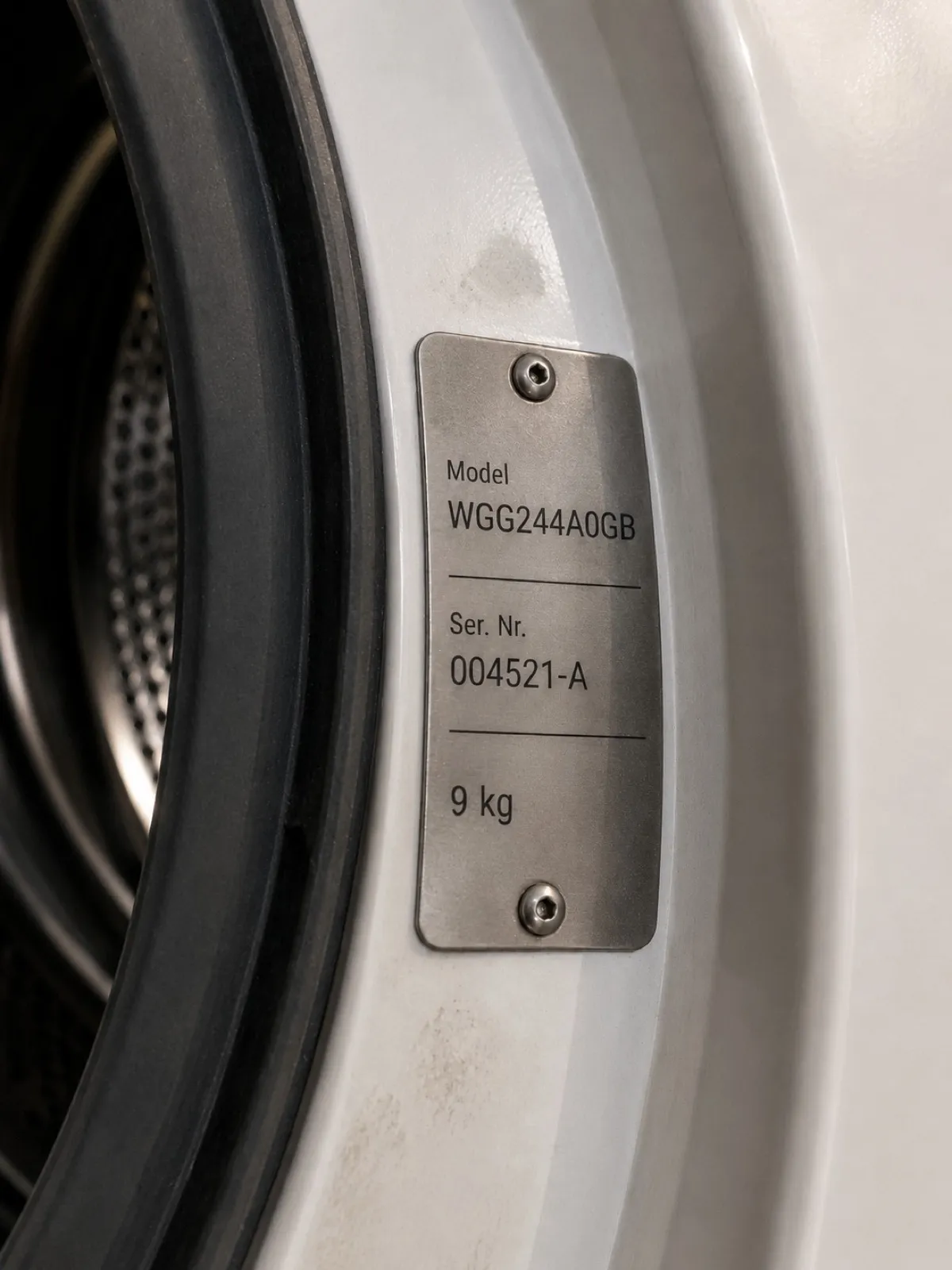
The short version: look for a printed or etched plate on the machine — inside the door, on the back, under the base, behind the kickboard. It carries several numbers. The one a parts site wants is usually labelled Model, Mod. or Type, not the long serial. Photograph the whole plate rather than copying one number, because you’ll be asked for a different one than you expected.
Where the plate is, by machine
Fridge and freezer. Inside, on the side wall near the salad drawer, or on the ceiling of the compartment. Occasionally on the back — which means moving it.
Washing machine and dishwasher. Open the door and look at the rim of the opening, or the inside edge of the door itself. On dishwashers it’s very often on the right-hand inner edge.
Oven and hob. Open the door and check the frame, or pull out the bottom drawer and look up. Built-in ovens often carry it on the side of the housing, visible only when the unit slides out.
Boiler. Behind the front cover, usually on a sticker inside. On many combi boilers it’s also printed on a card in the plastic wallet with the manuals — and that card is the single most useful piece of paper in a house.
Extractor hood. Remove the grease filter; the plate is behind it.
Tumble dryer. Inside the door opening, or on the back panel.
Television. Back panel, often near the input sockets. Modern sets also list it under Settings → Support → About.
Anything with a plug and no visible plate. Look at the bottom. If the machine is small enough to turn over, the label is nearly always underneath.
Which number they actually want
A plate is crowded. These are the ones that matter, and confusing them is the usual reason an order arrives wrong.
| On the plate | What it is |
|---|---|
| Model / Mod. / Type | The product. This identifies which machine you own, and it’s what a parts site asks for first |
| Serial / S/N | This individual unit. Wanted for warranty claims and recalls, not usually for parts |
| PNC or E-Nr | The manufacturer’s own product code — Electrolux uses PNC, Bosch, Siemens and Neff use E-Nr. If it’s there, it’s the most precise identifier and worth quoting |
| FD | Bosch group manufacture date. Sometimes needed alongside the E-Nr, because the same model changed parts mid-run |
| Rated power, voltage | Not identifiers. Ignore them for ordering |
The trap. Many machines were sold in several variants under one apparent model name, and the part differs between them. That’s what PNC, E-Nr and FD exist to disambiguate. If your plate has them, quote them — it’s the difference between the right door seal and a return.
Reading it when you can’t see it
Plates end up in bad places: behind kickboards, under counters, six inches from a wall, in the dark, etched rather than printed.
- Photograph rather than read. Reach the camera in where your head won’t go, then zoom in on the picture. Far easier than a torch and a mirror.
- Turn the flash off and use a torch from the side. Direct flash on a shiny etched plate is the usual cause of an unreadable photo. Raking light from an angle makes stamped characters legible.
- Watch the confusable characters. 0 and O, 1 and I, 5 and S, 8 and B. If a code doesn’t match on the parts site, try swapping those before assuming the plate is wrong.
- Long-press the text in the photo to copy it rather than typing it — both iPhone and Android will select printed text inside an image.
No plate at all
- The manual, if it survived. The model is usually on the cover or the first page.
- Your order history. Retailers itemise the full model on the invoice, and appliance orders stay in an account for years.
- The installer or engineer. Anyone who’s serviced it has the details on the job record.
- Inside the door frame of built-ins, once the unit is pulled forward — worth it before concluding there’s no plate.
So it’s there the next time
The reason people are on this page is almost never the first time they’ve looked for the plate. It’s the second or third, because the number was found once and then lost again.
Photograph the whole plate the next time you have it in front of you — including the numbers you don’t currently need, since the next request will be for a different one. Keeplea reads it and keeps the model, the serial and the codes as text, so the dishwasher returns the dishwasher with its numbers rather than a photo you have to squint at. It sits with the receipt and the certificate too, which is what an actual warranty claim needs.
While you’re at it, do the boiler and the oven. It’s two minutes and it’s the same trip you’ll otherwise make in a hurry when something breaks.